
Finding Post Falls Residents
Begin with the strongest fact already known. An address belongs in the Kootenai County Assessor search, where the parcel number, legal description, situs address, owner, transfer reference, and building traits can establish the property. A name may work better in the Recorder party index, Idaho iCourt, a current voter self-check, or an older directory collection. For an earlier era, newspapers and regional directories usually produce more than a modern portal.
Ownership does not equal occupancy. Tax mail may go to another city, a trust, or a post office box, and renters rarely appear on the assessment roll. Likewise, a court party match does not prove that the named person lives at the address. Build a Post Falls residents directory result from independent facts such as a middle name, date, parcel, related instrument, or known household member.
- Search the county property roll by owner or street address, then save the PIN, AIN, and legal description.
- Check the appropriate name index, such as iCourt, the Recorder, or a historical catalog, and narrow it with dates.
- Follow an instrument number into the deed index instead of expecting the street address to be the deed key.
- For older residents, compare a directory year with newspaper microfilm, a Sanborn map, or a school census.
- If the needed public record is not online, send a narrow written request to the office that holds it.
Post Falls Records Custodians
Most resident records for Post Falls are kept outside City Hall because Coeur d'Alene is the Kootenai County seat. The Assessor maintains the current parcel roll, the Recorder keeps recorded instruments, and Elections handles voter reports. Each office answers a different question. City records, including permits and council files, go through the Post Falls City Clerk. Address-level techniques are developed further in the Post Falls street directory.
Kootenai County Recorder
451 Government Way
Coeur d'Alene, ID 83814
208-446-1480
Kootenai County Assessor
451 Government Way
Coeur d'Alene, ID 83814
208-446-1500
Kootenai County Elections
1808 N 3rd Street
Coeur d'Alene, ID 83814
208-446-1030
Post Falls Parcel Search Fields
The free Kootenai County Assessor search accepts a full 12-character PIN, six-digit AIN, owner name, property address, or legal description. In owner mode, enter the last name first and start with less text. Address searches need the street spelled out, though an asterisk can broaden a partial word. The result card can show the owner, assessed value, parcel number, short legal description, lot size, transfer date and instrument, plus building details.
Keep the physical, or situs, address separate from the tax mailing address. The former identifies the mapped parcel. The latter only identifies where tax notices go. The screenshot below shows the official entry point rather than a copied list of residents.
Open the official Assessor property search to see its current controls.
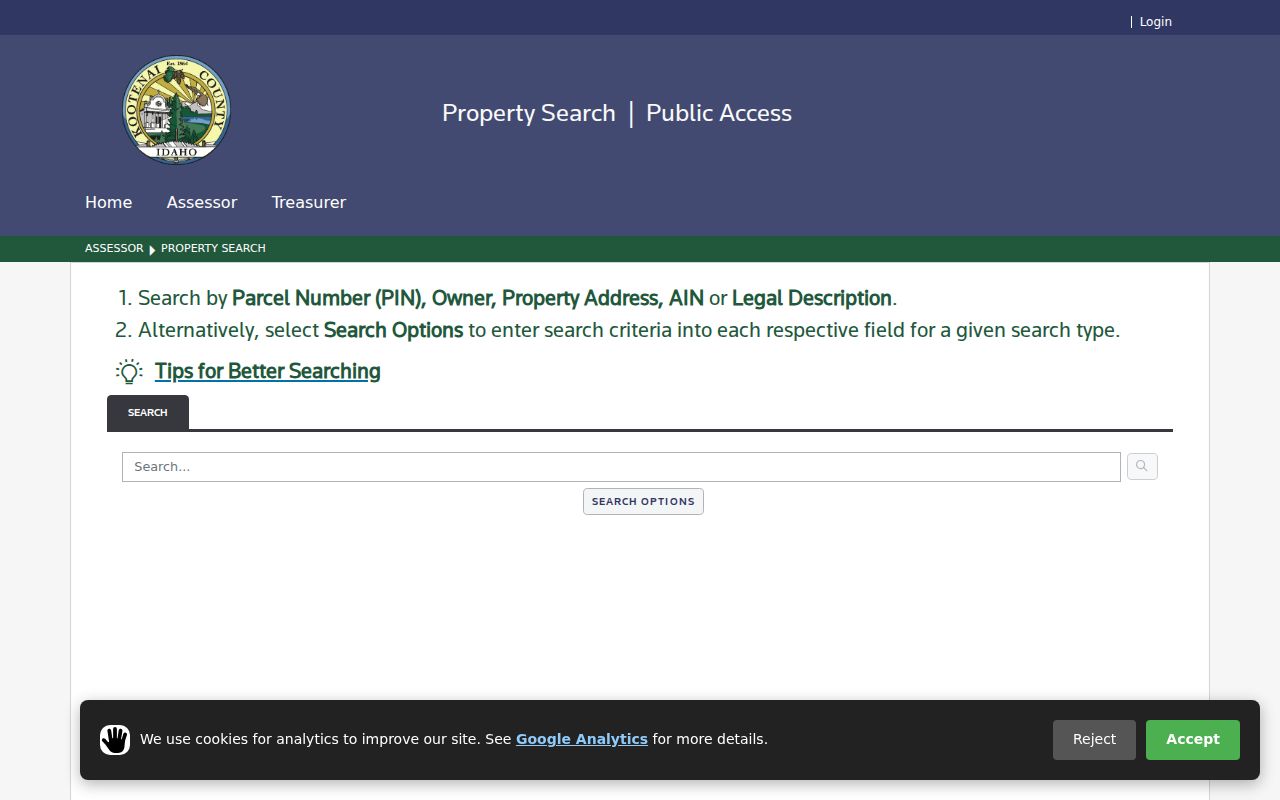
Use the resulting parcel identifiers to move into the deed and mapping records without assuming the listed owner occupies the home.
Post Falls Deeds by Instrument
The Kootenai County Recorder says its custody reaches back to 1881, while county online guidance emphasizes modern searching from 1996 forward. Searchers can use party name, instrument number, or legal description. The legal description from the Assessor is often more reliable than a street string because recorded deeds are indexed to parties and land, not to a residents directory.
A 2026 portal change imported plats, surveys, and corner records into Public Access. Codes SS, SP, and SL identify those document types. They can clarify how a parcel changed when a simple deed chain is hard to follow. Older, certified, or difficult records remain available through the Recorder counter or by mail. Current guidance lists online viewing as free and ordinary copies at $1 per page, subject to verification before ordering.
- Instrument
- The unique recorded-document number used to retrieve a deed or filing.
- Grantor
- The party giving or transferring an interest.
- Grantee
- The party receiving that interest.
- Index
- A finding tool; it is not always the complete document image.
The Recorder Real Estate Search pictured here is the official deed-index route.
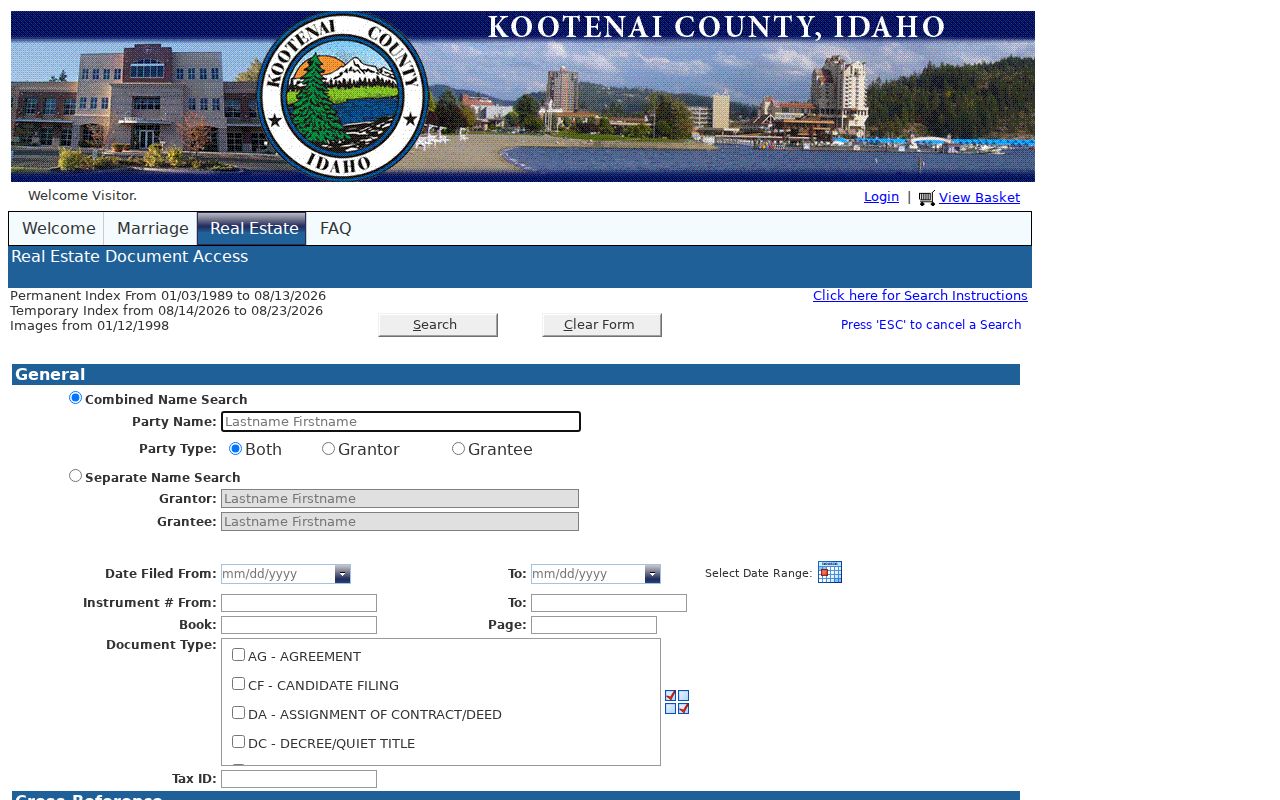
Copy the instrument number and recording date before opening the next link in a chain.
Current Post Falls Directory Sources
Current official sources list selected groups, not every Post Falls household. Choose the roll that was created for the fact being checked. The table separates property ownership, registered voters, recorded parties, city staff, and court parties so that one limited list is not mistaken for the whole city.
| Source | Who It Lists | Keeper | Access |
|---|---|---|---|
| Property assessment roll | Parcel owners | County Assessor | Free portal |
| Voter record | Registered voters | County Elections | Self-check or lawful request |
| Real Estate Index | Parties to recorded instruments | County Recorder | Free index |
| City staff directory | Current municipal contacts | Post Falls | Free online |
| iCourt Smart Search | Parties in public cases | Idaho Courts | Public docket search |
No result proves current residence on its own. Compare name spelling, dates, party roles, and address context in the Post Falls resident lookup workflow. Renters, minors, and people using lawful address protections can be absent from these sources.
Verifying Post Falls Court Names
Idaho's iCourt Smart Search covers trial-court dockets, including Kootenai County in the First Judicial District. Search by case or record number when one is known. A party-name search can use last and first names, business names, a wildcard, and advanced filters. Case details may show the case number, court, type, status, filed date, party roles, hearings, and public register entries.
A docket is only a list of case activity. It is not the complete court file, and sealed or exempt matters may return nothing. Copies and files that are not exposed online go through District Court Records at the Justice Building. Federal District of Idaho cases use PACER, with a free courthouse terminal available for local access.
The current iCourt portal is shown below.
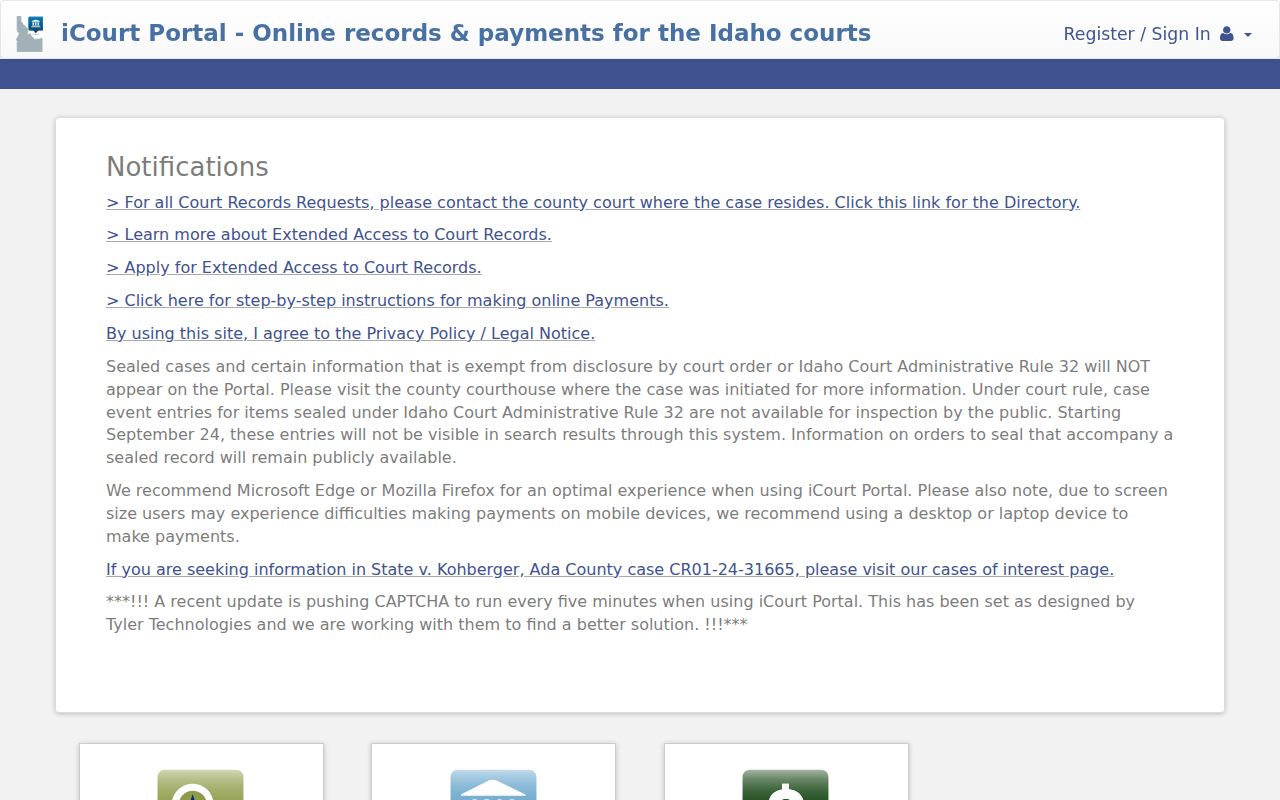
Match county, dates, and party role before treating a common name as the same person.
Post Falls Voter Record Limits
VoteIdaho provides a dynamic self-check using name, birth date, and an anti-automation challenge. It is meant for a voter to confirm registration. A broader public voter report comes from Kootenai County Elections and requires a defined geography, report choice, requester details, and use certification.
Idaho law can make name, street and mailing address, county, age, gender, party, supplied phone, and yes-or-no participation history public under specific limits. Full birth date, driver-license data, signatures, protected addresses, and ballot choices are not public. The current county form offers CSV or spreadsheet delivery by email; a large report on USB carries a stated $4 fee. It also forbids outside sharing and commercial use.
See the official voter self-check before relying on an old registration.
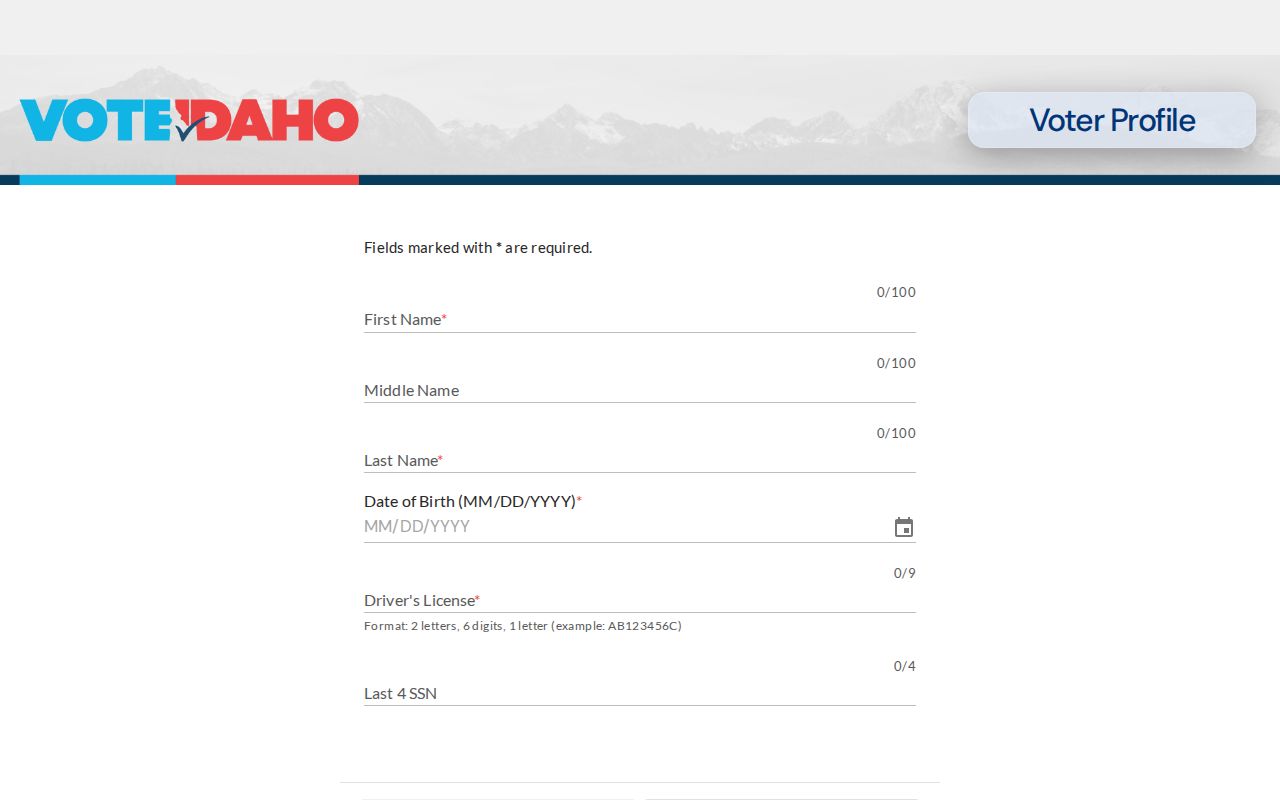
The live form checks a registration; it does not reveal how anyone voted.
Post Falls Vital Record Boundaries
Idaho Department of Health and Welfare issues certified birth, death, marriage, and divorce certificates. These are application records, not open resident-name indexes. Idaho keeps birth certificates restricted for 100 years and death, stillbirth, marriage, and divorce certificates restricted for 50 years. During those periods, the applicant needs an eligible relationship or other direct and tangible interest, acceptable identification, and sometimes more proof.
A certificate currently costs $16, with an optional $10 rush service. DHW publishes mail and VitalChek routes, but has no public counter and does not issue certificates by email. A divorce certificate confirms the event; the decree comes from District Court. For an older family-history question, newspapers, cemetery records, county files, archives, and indexed historical collections are often the lawful starting points.
The Idaho birth-certificate instructions show the access and proof rules.
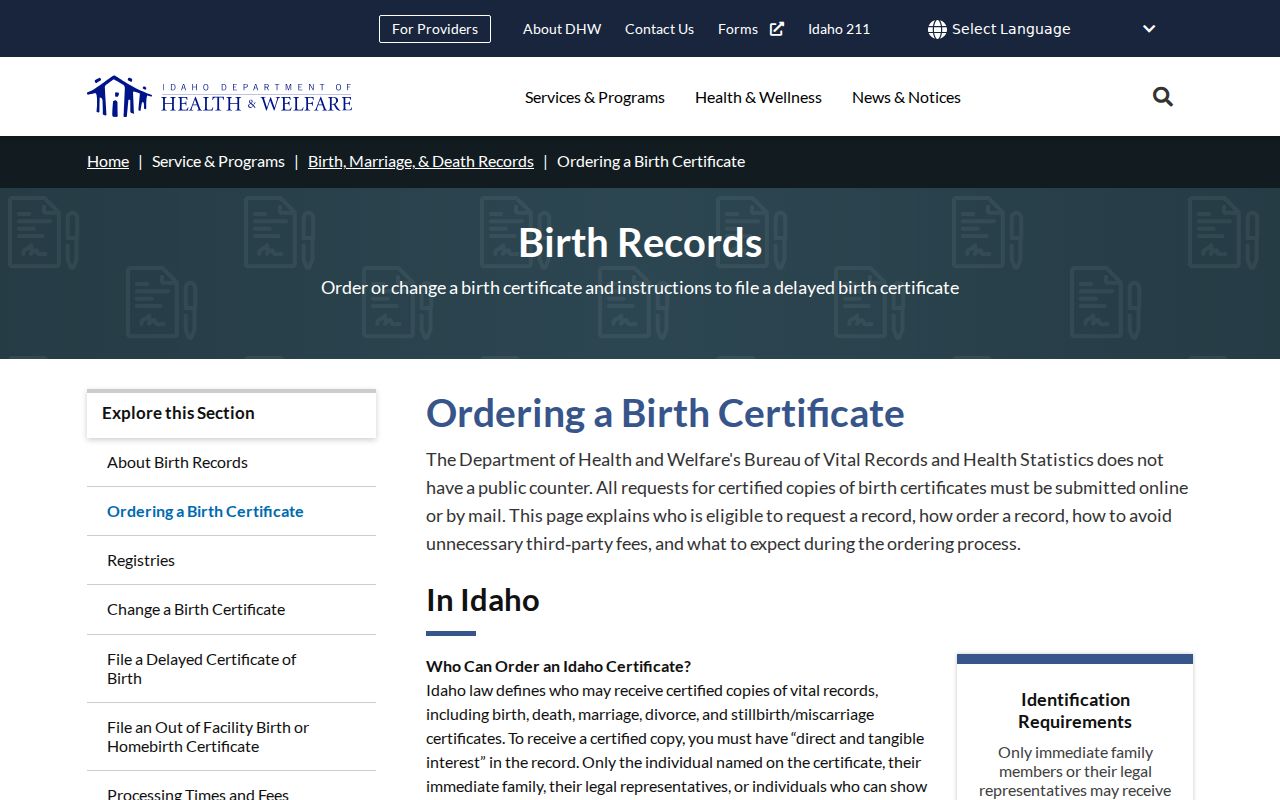
The order page is a controlled certificate route, not a way to browse current Post Falls residents.
Historical Post Falls Directories
Post Falls is routed through “See Coeur d'Alene” in the University of Idaho's regional directory holdings, so a search should not assume a separate Post Falls volume exists for every year. The collection includes regional telephone and business books, while University microfilm supplies a local newspaper trail: the Post Falls Gazette from 1889, the Advance from 1913 through 1948, and the Tribune from 1964 forward.
The Museum of North Idaho holds city directories, phone books, census material, marriage abstracts, school censuses, cemetery lists, probate sources, and oral histories. Its research service may take one to two weeks and lists a $30 hourly rate, with a member exception for the first hour. The Post Falls Historical Society and Museum has no verified online holdings catalog, so a direct, specific request for an address file, photograph, ledger, or oral history is better than claiming that its archive can be searched online. Full collection guidance appears in the Post Falls city directory.
How Post Falls Records Changed
Kootenai County was established in 1864. Its seat moved from Seneaquoteen to Rathdrum in 1881 and then to Coeur d'Alene in 1908. County splits in 1907 and 1915 also changed regional labels. Post Falls incorporated in 1891. These dates explain why an early land, court, or newspaper record may point to a different seat or repository even when the place is now within Post Falls.
Government birth recording began around 1907, statewide birth and death custody followed in 1911, and statewide marriage and divorce certificates begin in 1947. Earlier lives may appear only through a land instrument, newspaper notice, church or cemetery entry, school census, or family collection. Always record both the office that created an item and the library, archive, or court that now holds it.
Local detail. The community library grew from five shelves in a private home in 1910, moved into an empty bank room for $19 in 1933, and joined its regional network in 2010.
Privacy in Post Falls Lookups
A missing street address can be intentional. Idaho's Address Confidentiality Program gives qualifying survivors a substitute mailing address and confidential voter-registration handling. Covered circumstances include domestic violence, sexual assault, stalking, malicious harassment, and human trafficking. Certification lasts four years and has renewal or cancellation procedures.
The program is a safety control, not an invitation to reverse-engineer a person's location. Court sealing, vital-record restrictions, protected voter fields, juvenile rules, and active-investigation limits create other lawful gaps. If a source says an address or file is protected, stop there and use the published custodian process.
The Idaho ACP overview explains the substitute-address program.
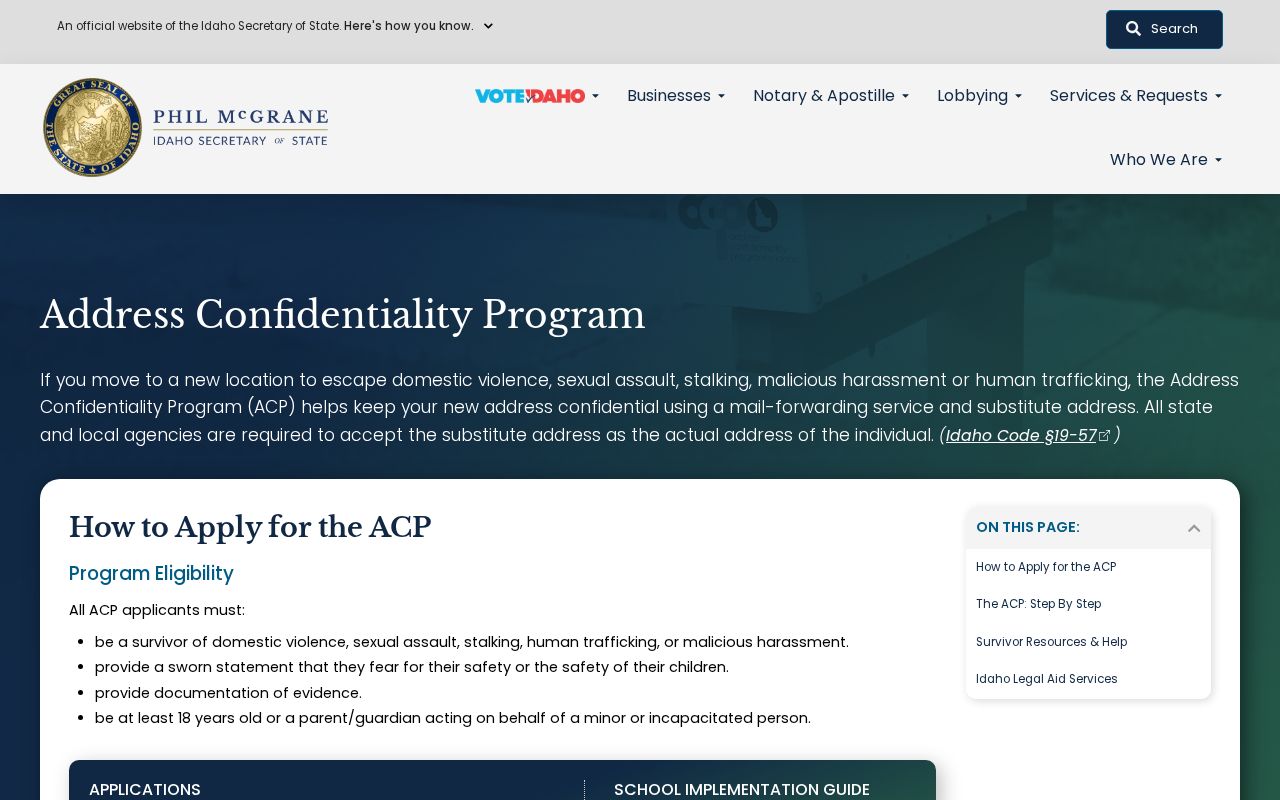
Absence from an ordinary public result should never be used to challenge a protected person's connection to Post Falls.
Current Custody and Jail Records
The Kootenai County Sheriff In-Custody Report publishes current downloadable files and separate links for wanted persons, press logs, and VINE notifications. It is a dated custody source, not a historical Post Falls directory. Save the report date and avoid treating a later absence as proof that no prior custody record existed.
The state Department of Correction maintains a separate resident/client search that updates daily and requires a last name or IDOC number, with first name optional. Status and location can change. Both sources cover only people in their systems and must not be used to generalize about a neighborhood or household.
The Sheriff's current-report page appears below.
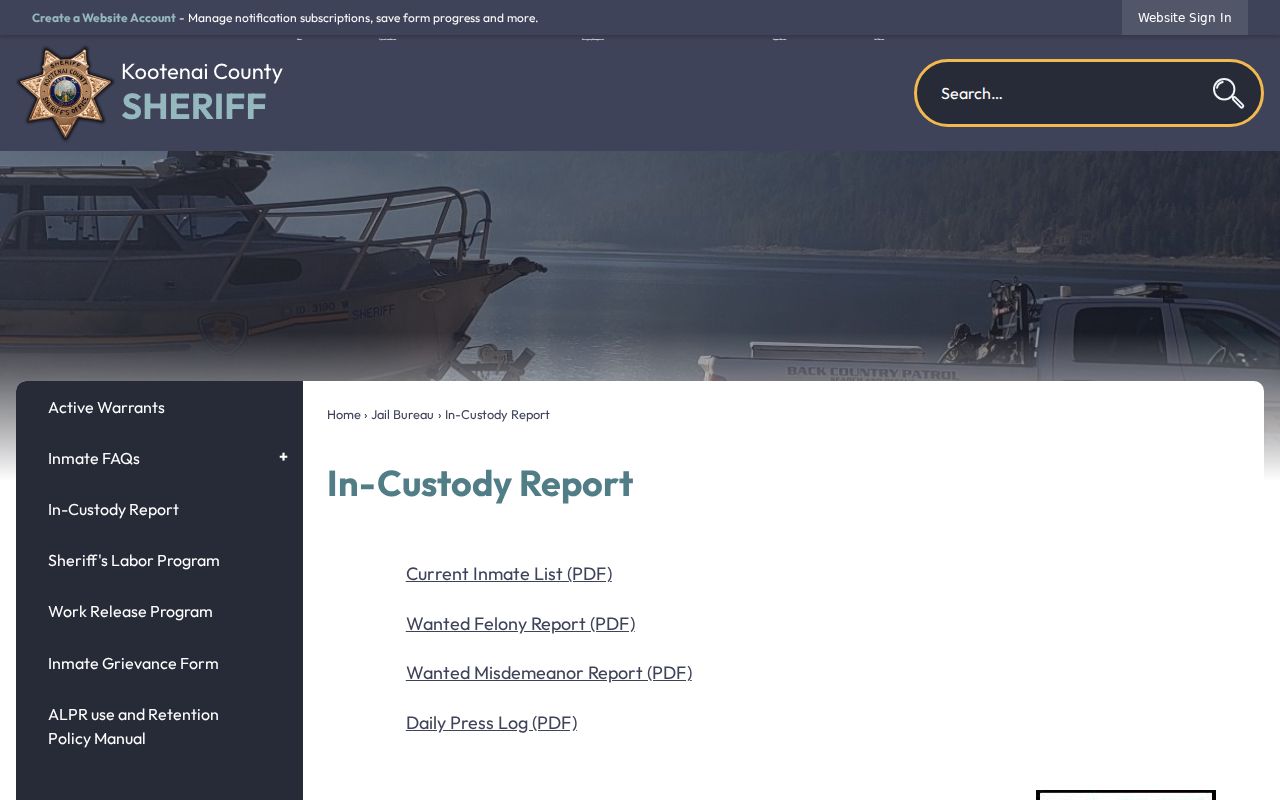
The page's date and report label are essential context for any name found there.
Requesting Post Falls Public Records
Idaho Public Records Law, Idaho Code §§74-101 through 74-127, requires a request to reach the actual custodian. Include a name and contact details, a precise record description, date range, department, desired format, and whether inspection or copies are sought. Idaho-resident status can affect timing and fee treatment. A general request to “find everything” is unlikely to work because county research-room staff identify records and explain tools but do not perform open-ended research.
The initial grant or denial decision for a reasonably available resident request is generally due within three working days. Longer retrieval can trigger notice and a period of up to ten working days for Idaho residents; nonresident rules differ. The first two staff hours and 100 pages are generally free under ordinary resident-request rules, after which qualified labor and actual reproduction costs may apply. Specific voter, court, vital, and police records still follow their own processes.
The Kootenai Clerk request-routing page identifies the right county channel.
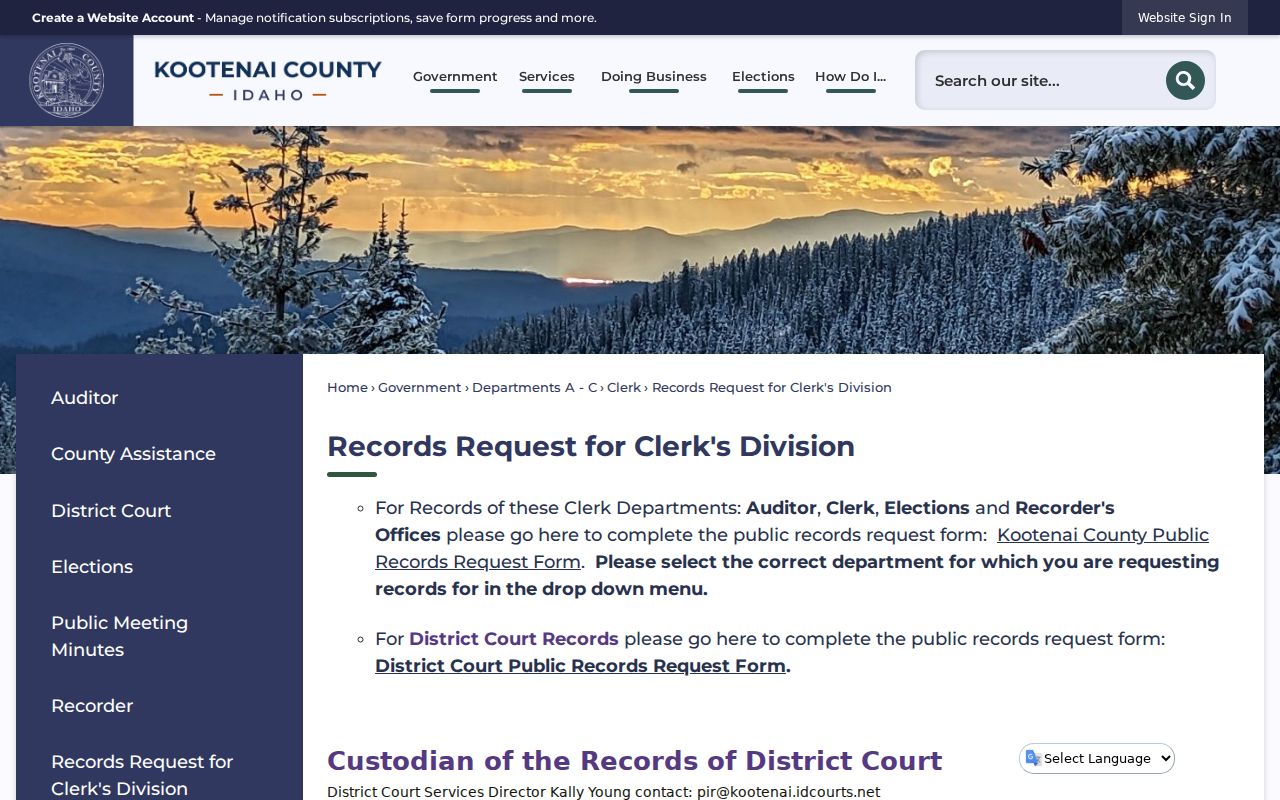
Use its office-specific contact rather than sending one request to several unrelated custodians.
Safe Post Falls Record Checks
Local phishing warnings make source verification part of the search. Post Falls Police warned in January 2025 about an impersonation message and false invoice. Later city alerts described fraudulent application-fee messages and stated that the city does not ask applicants to send wire transfers. Official city mail uses postfalls.gov or the approved OpenGov portal.
Open an official agency page first, then use the phone number shown there to confirm an unusual payment or request. Do not trust caller ID, an attached invoice, or a copied department logo. The free Idaho Unclaimed Property portal also warns that no finder fee is needed. Keep only the personal data needed to document a result.
Lawful use. Never use directory information to stalk, harass, intimidate, expose a protected address, or harm another person.
Note: Current portals, rosters, map layers, and fees can change, so preserve the source URL and the date checked.