
Post Falls Directory Shelf Map
The University of Idaho catalog gives the clearest year map, but its key instruction is easy to miss: for Post Falls telephone directories, see Coeur d’Alene. That regional filing choice means a failed catalog search for a stand-alone Post Falls title is not the end of the search. The table separates actual holdings from companion sources that add names, addresses, notices, or building context.
| Collection | Years | Where Held | Access |
|---|---|---|---|
| Regional business books | 1905, 1908, 1911, 1912/13, 1914/15, 1916/17, plus selected later runs | University of Idaho Special Collections | Holdings list; confirm volume access |
| Coeur d’Alene telephone books | 1930; 1947–54; 1956–65; 1967–70; 1972–78; 1981–96; 1998–2002; 2004/05 | University of Idaho | Post Falls filed through regional books |
| Post Falls newspapers | Gazette from 1889; Advance 1913–48; Tribune from 1964 | University of Idaho microfilm | Reading-room and staff route |
| City directories and local files | Repository-specific | Museum of North Idaho | Appointment or research request |
| Sanborn maps | 1890, 1908, 1912 verified | University of Idaho digital collection | Free online building cross-check |
No verified open digitized Post Falls city directory item or public reverse-directory run was located. The holdings list is a finding aid, not a scanned name index. Ask the repository to confirm the year, title, call number, condition, and access rule before planning a visit or paid request.
The runs are not annual and should not be described as continuous. Coeur d’Alene business holdings include 1912–13, 1916–17, 1947, 1952, 1955/56–1960, 1962–64, 1970–72, 1980–84, 1987, and 1989. Regional titles add 1905, 1908, 1911, 1914/15, and other county combinations. Always read the title page to learn which communities and kinds of listings the publisher chose.
A separate Idaho State Historical Society holdings list may add mid-century Kootenai volumes. It is also a catalog aid, not a searchable copy of each page. Confirm the exact book and call number with the repository. Keeping these two holdings lists distinct prevents an apparent year in one institution from being mistaken for a digitized Post Falls volume available everywhere.
Post Falls Hides Under Coeur d’Alene
Open the University of Idaho directory holdings and follow its “See Coeur d’Alene” instruction for Post Falls. Regional volumes may cover several North Idaho communities in one book. Early runs include Kootenai, Bonner, Shoshone, Benewah, or Boundary County combinations, so the title page and publisher’s coverage note matter as much as the index.
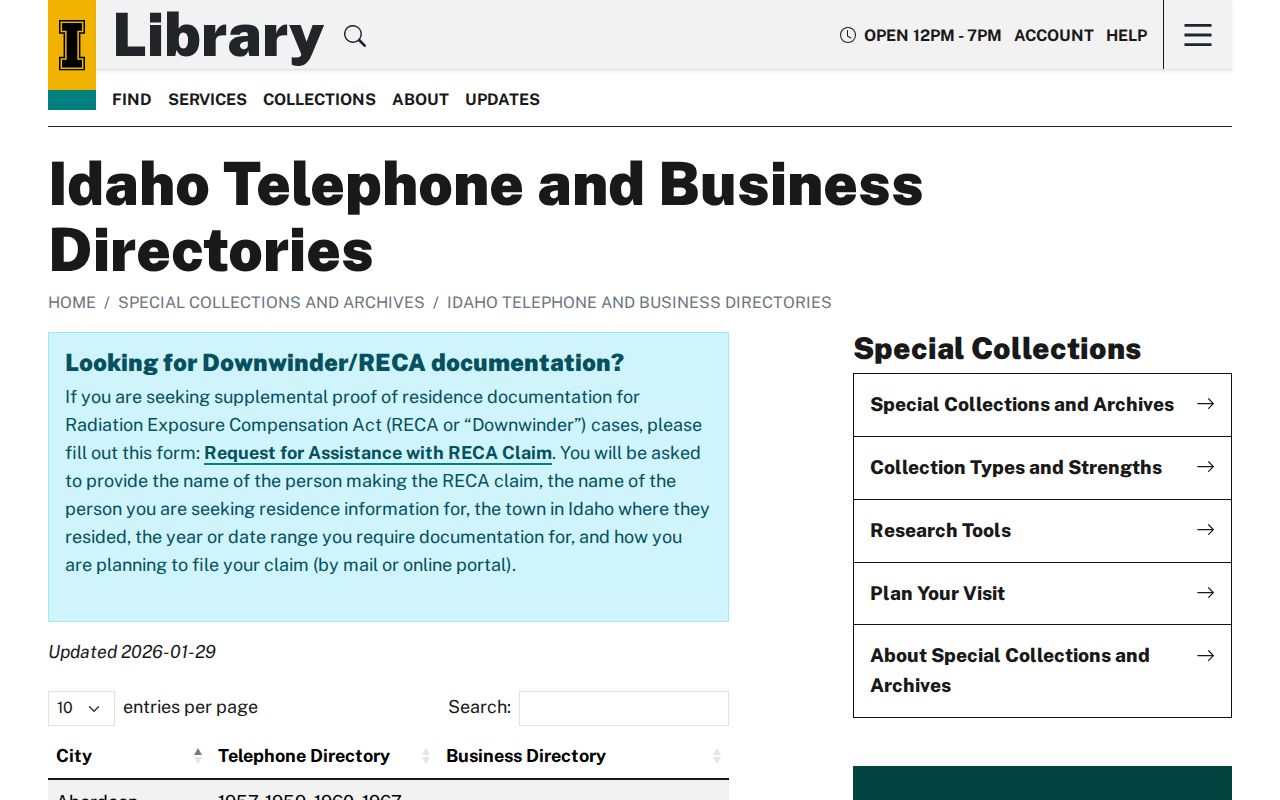
The captured holdings table is the catalog crosswalk that prevents a false “no directory exists” conclusion. Search spelling variants, then inspect the community and street sections inside the correct regional volume.
The earliest listed regional business books provide trades, firms, and addresses as printed. The 1930 phone book is the first concrete telephone starting point in the U of I list. Both omit non-subscribers and people outside the publisher’s chosen coverage, so absence is only a gap in that book.
A regional label can also change how a surname is indexed. Search Post Falls, Coeur d’Alene, Kootenai County, and the name of a business or landmark. Check the community heading before assuming every similarly named entry belongs in Post Falls. If only a holdings PDF is available, send the repository a narrow request with the volume year and name rather than asking staff to search the entire run.
The county-seat trail adds another catalog issue. Kootenai County’s seat moved from Seneaquoteen to Rathdrum in 1881 and to Coeur d’Alene in 1908. County boundary splits followed in 1907 and 1915. A person or property tied to Post Falls may therefore appear under a regional office, older county label, or nearby publication even when the event happened within today’s city area.
Read a Post Falls Entry
Transcribe what the city directory actually prints. Do not expand an abbreviation until the volume’s own key confirms it. Keep the directory year and page attached to every copied line because regional boundaries, names, addresses, and publication practices shift. A spouse or household marker may appear, but no single format is promised for every Post Falls regional book.
| Printed identity | Surname, given name or initials, and any spouse or household marker |
|---|---|
| Work line | Occupation, trade, firm, or business address exactly as printed |
| Place line | Street, house number, cross-street, ward, or telephone listing |
| Source line | Year, publisher, page, repository, call number, and image reference |
| Status note | Any “removed,” “see,” or other cross-reference language |
- Criss-cross directory
- A volume or section ordered by street and house number. No verified Post Falls title or year list was found online.
- Householder index
- A name or address arrangement identifying the person printed as responsible for a listing, not necessarily every household member.
- Abbreviation key
- The publisher’s legend for shortened terms and symbols. Save it with the entry before interpreting marks.
Save an image of the title page and abbreviation key with each entry when repository rules allow it. Record whether the listing comes from a telephone section, business section, name index, or street-order section. A phone subscriber may not own the home. A business address may differ from the person’s residence. Owner or renter symbols should be reported only when that volume defines them.
Spelling must stay faithful to the print. Initials, widowed-status notes, “removed” lines, and “see” references can resolve two people with the same surname. Yet they can also reflect publisher conventions or stale copy. Compare the next available year and a second source before treating a notation as a life event.
Telephone numbers also change meaning across the run. An early number may identify a subscriber, firm, or shared line, while later books may suppress an unlisted household. Keep the number exactly as printed and do not normalize it to a modern format. If the same number appears with a new surname or address, record the change as a directory event and seek a newspaper or land-record explanation.
Post Falls Directory Newspaper Trail
Newspaper runs extend the local name-and-address trail beyond the city directory shelf. The Post Falls Gazette begins March 1, 1889 in the U of I microfilm list. The Post Falls Advance runs from February 21, 1913 through October 26, 1948. The Post Falls Tribune begins in January 1964 and continues. Legal notices, obituaries, land sales, school news, and civic items can bridge a missing book year.
Check the University of Idaho newspaper microfilm table before requesting a reel.
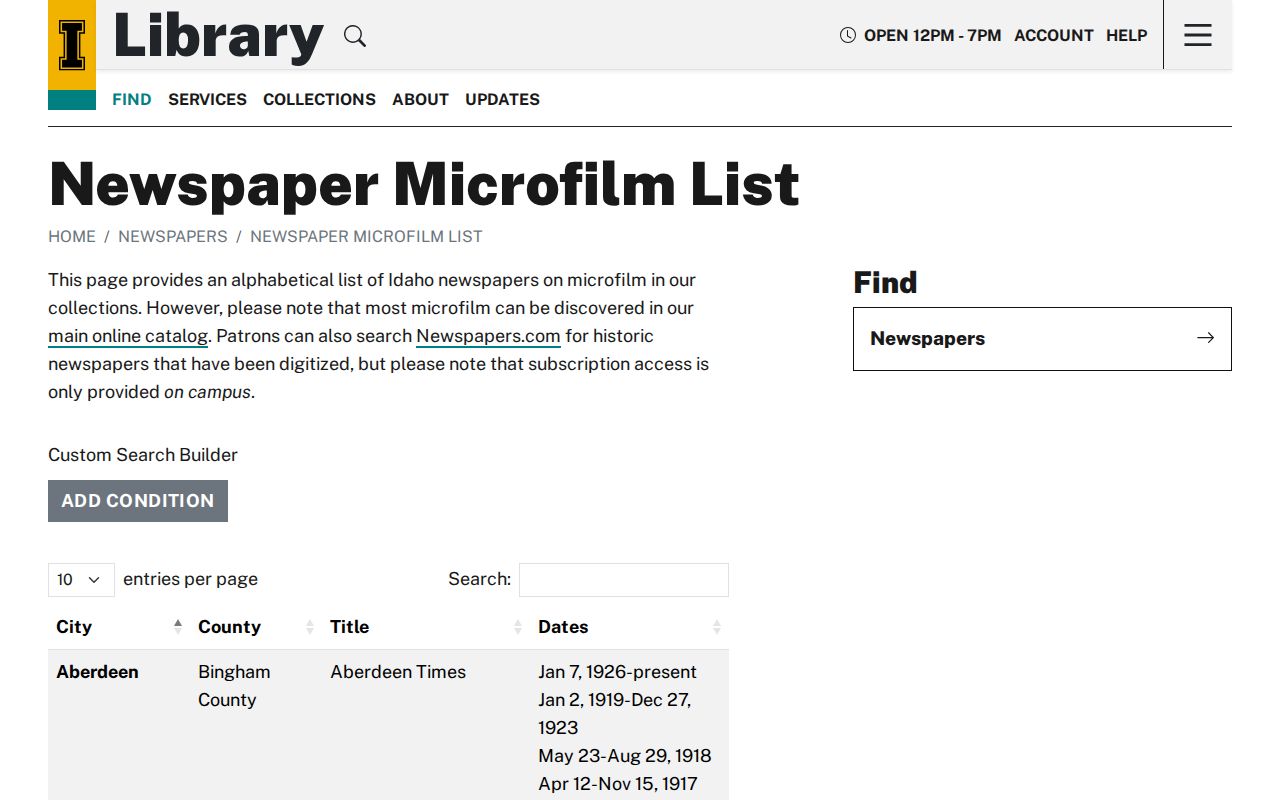
The list supplies publication dates and repository context. Search exact address first, then street without the number, surname with Post Falls, legal-notice terms, a business name, and regional Coeur d’Alene spelling. A newspaper statement remains a dated clue, not a deed or certificate.
No official online Post Falls obituary index was located. Ask a reference librarian to check the known publication and date range, then compare a notice with cemetery, probate, death-index, or lawful certificate evidence. The Rathdrum Tribune reel also covers late 1963 before the Post Falls Tribune run begins, which may close a short transition gap. Record the reel, issue date, page, and notice type with any extracted name.
Post Falls Directory Library Trail
The local library’s own history shows why early records may survive as clippings and reference material rather than a clean database. Service began with five shelves in Annie Patterson’s home in 1910, moved to Nogle Hall in 1912, and received a charter in 1915. A dedicated building followed in 1966, computerized circulation in 1987, and network membership in 2010.
The Post Falls Community Library does not publish a full city-directory, reverse-book, or obituary-index inventory. Ask the reference desk about regional phone and business books, yearbooks, church histories, newspapers, cemetery material, local maps, and address crosswalks. Confirm any licensed database before relying on it.
| 1910 | Five-shelf home library begins |
|---|---|
| 1915 | Library receives its charter |
| 1966 | Dedicated building opens |
| 1987 | Circulation becomes computerized |
| 2010 | Branch joins the network |
Library staff may also know local street-name changes, clipping files, yearbooks, church histories, and cemetery references that do not appear in a web catalog. Phrase the request around one person, address, and date range. Ask whether copies can be made, whether a visit is needed, and how the source should be cited. Do not assume the branch subscribes to a specific database until staff confirms current access.
The library timeline is useful evidence about custody, not a claim that every old item survived each move. The 1933 transfer to an empty bank back room reportedly cost $19, and the 1942 budget was $250. Those local details explain why a clipping, donated book, or staff file may need a direct reference-desk inquiry instead of appearing in an online catalog.
Post Falls Directory Archive Fallbacks
When the book index stops, three repositories offer staffed routes. The Post Falls Historical Society formed in 1988 and opened its museum in 2009 in an early 1923 building at 4th and Spokane. Its website does not list a searchable holdings catalog, so ask directly about address files, mill or railway photographs, school records, ledgers, and oral histories.
The Museum of North Idaho research library names city directories, phone books, school annuals, a 1910 state census index, Kootenai marriage abstracts, school censuses, cemetery listings, probate material, and oral histories among its holdings.
The captured research page supports an appointment or written request. Published service is Tuesday through Thursday, 10:00 to 5:00 by appointment, with a one-to-two-week response window. Research is listed at $30 per hour, with the first hour complimentary for current members.
The Idaho State Archives genealogy desk adds histories, gazetteers, family files, microfilm, vital-record guides, and request help. Kootenai is not among the selected counties shown in its public index list, so describe the needed name, place, date range, and record type in a staff request.
The Archives research room is listed at 2205 Old Penitentiary Road in Boise, open Wednesday through Saturday from 10:00 to 4:30, with phone and email request channels. The Museum of North Idaho is at 720 E Young Avenue in Coeur d’Alene and lists 208-664-3448. The Post Falls Historical Society lists 208-262-9642. These staffed access points matter because catalog gaps are not proof that a file or volume does not exist.
FamilySearch adds place, keyword, title, author, subject, surname, availability, and call-number search routes. Its Kootenai school census catalog covers 1898–1910 on three reels and warns that districts may be missing. Inspect the catalog notes and images where access permits. A school census can connect a child and household to a district, but should not be presented as a complete Post Falls city directory.
Evergreen Cemetery is another request-level route. The city supplies location and contact information, while an Idaho State Archives catalog entry covers Kootenai cemetery material for 1983–1998. No open citywide interment-name database was found. Send a narrow name, date, and lot question, then compare any response with the newspaper and archive trail.
Map Post Falls Directory Addresses
Sanborn sheets from 1890, 1908, and 1912 give three verified physical snapshots. They show streets, building footprints, materials, rail or water context, and landmarks. They do not name every resident. Use a map to test whether an address in a regional book points to the same structure or to an older lot later split, combined, rebuilt, or renumbered.
Post Falls grew around the Spokane River mill and hydro site. Frederick Post’s 1871 mill connection, the 1902 fire, and the 1905 rebuild supply a local timeline for map and newspaper research. Keep that physical story distinct from household evidence. A building’s survival does not prove that a listed family remained there.
Current address rules place the city grid origin at Spokane Street and 1st Avenue, but no authoritative historical renumbering chronology was found. Preserve the address exactly as printed, then compare its street, lot, landmark, and building footprint with the map year. The modern county parcel and legal description can anchor later land research, while the old map tests only physical continuity.
Trace Post Falls Family Years
A Post Falls city directory works best as one dated link in a longer family-history chain. Start with a known year and a regional volume. Move forward and backward to the closest available books, then use newspapers and maps for gaps. Census, school, cemetery, probate, and vital sources have their own access rules and should confirm only the fact each record can support.
- Choose the closest regional directory year and record title, publisher, page, and repository.
- Transcribe the printed name, address, phone, trade, and all cross-references without silently modernizing them.
- Check the next available year in both directions. Mark a move, spelling change, missing year, or unlisted status as a separate event.
- Pair the city directory entries with a census year, school census, newspaper notice, or Sanborn sheet that covers the same period.
- Close the trail with an obituary, cemetery request, probate file, or lawful vital-record route, while keeping each source’s limits visible.
A disappearance can mean a move, death, changed spelling, unlisted telephone, missed community, or a gap in holdings. It does not settle which explanation is right. The Kootenai school census catalog covers 1898–1910 on three microfilm reels, though districts may be missing. That makes it a useful household and district clue for children, not a substitute for a full city directory.
Record uncertainty in plain terms: “directory year missing,” “regional coverage unclear,” “address normalized from historic form,” or “newspaper clue not yet confirmed.” Those labels keep the family timeline useful without turning an inference into a fact.
When a name continues at the same address, note the precise years actually checked rather than writing “always lived there.” When the address changes, search the old and new streets in newspapers and maps. If a person vanishes, check the next available volume, the obituary trail, and probate or cemetery routes before deciding why. Historical directories are snapshots shaped by subscriptions, publisher coverage, print deadlines, and the surviving shelf.